Who Should Attend?
This qualification is for people who are required to hold a regulated and nationally recognised Level 3 prehospital care qualification and for those who intend (or have a specific responsibility at work, or in voluntary and community activities) to provide prehospital emergency care as a Level 3 First Response Emergency Care (FREC®3) provider.
It is ideal for those looking to equip themselves with lifesaving skills to prepare them to be amongst the first to arrive at a scene of an emergency, including first responders such as police officers, firefighters, emergency medical services and search and rescue personnel.
It is also ideal for those providing event medical cover or roles such as First Responders, Door Supervisors, Close Protection Operatives and Security Guards, as well as those working in high-risk environments including the military, power stations, offshore renewable energy, agriculture and manufacturing settings.
FREC®3 providers work in a wide range of workplaces and environments providing prehospital emergency care, having direct contact with service users or others and providing high quality and compassionate care.
Learners must be at least 17 years old on the first day of the training.
There are no other formal entry requirements but to benefit from the learning we advise that Learners have a minimum of Level 2 in literacy or equivalent and a basic understanding of first aid.
Duration
5 days
Location
Ipswich / Essex / In-house Availability
Certifications
Provided on completion
Course PDF
View course details as PDFCourse Aims and Objectives
By the end of the course delegates will:
- Understand the role and responsibilities of a first responder
- Be able to assess a scene, summon assistance and initially manage an incident
- Be able to assess and manage patients with life-threating and nonlife-threatening illness and injuries
- Be able to assess a patient’s airway
- Be able to manage and maintain a patient’s airway
- Be able to manage an unresponsive patient who is not breathing normally
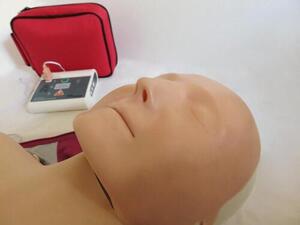
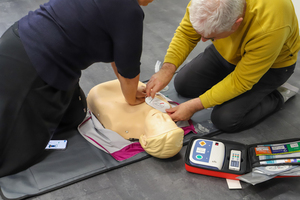
- Be able to safely use an AED during a resuscitation attempt and knows how to maintain an AED ready for use
- Be able to administer medical gases
- Understand the importance of mechanism of injury, energy transfer, injury prediction and how they relate to individual patient care
- Be able to assess, treat and manage trauma patients within scope of practice
- Be able to assess and manage life threatening blood loss
- Be able to assess and manage chest injuries
- Be able to assess and manage wounds and bleeding
- Be able to assess and manage a patient with compromised circulation
- Know how to assess and manage wounds and eye injuries
- Know how to assess and manage a patient with burns or scalds
- Know how to manage a patient with sudden poisoning
- Be able to provide prehospital emergency care to a patient with head, spinal and musculoskeletal injuries
- Be able to move and handle people in an emergency to a place of relative safety
- Be able to assist clinicians packaging, moving and handling patients
- Be able to assess a patient who is unwell within scope of practice
- Know how to identify and manage a patient experiencing breathing difficulties
- Know how to assess and manage a patient with suspected major illness
- Be able to manage an unresponsive breathing patient
- Know how to provide prehospital emergency care to patients who have been overcome by situational or environmental factors
Course Outline
- Role and responsibilities of a first responder
- Operational readiness and human factors
- Emergency services capabilities
- Structured patient assessment
- Mechanism of injury and incident
- Life threatening bleeding control
- Airway management and emergency oxygen
- Breathing difficulties (trauma and medical)
- Prehospital trauma care
- Prehospital emergency medical care
- Responding to changes in risk and/or threat
- Primary triage (Ten Second Triage) and lifesaving
- interventions
- Moving and handling: in an emergency and
- assisting a clinician
- Recording assessment findings
- Environmental exposure
- Immersion and submersion incidents
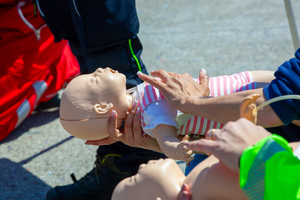
- Adult, child and infant BLS and AED usage